
Biocybernaut Data Shows Alpha Training Reverses Brain Aging in Adults Over 70
Join Dr. James Hardt live: Biocybernaut Webinar, August 19, 2026. Register at www.biocybernaut.com. SEDONA, AZ, UNITED
Press Release Disclaimer: This is a press release distributed through the XPR Media network. It has not been independently verified by our newsroom.

Join Dr. James Hardt live: Biocybernaut Webinar, August 19, 2026. Register at www.biocybernaut.com.
SEDONA, AZ, UNITED STATES, August 18, 2026 /EINPresswire.com/ — The Biocybernaut Institute, a neuroscience training center that has worked with older adults since its founding in Sedona, Arizona on July 4, 1976,
reports that participants in their 70s, 80s and 90s have produced Alpha brainwave signatures consistent with people in their 30s and 40s after completing the Institute’s seven-day
Alpha One program. The Institute’s Founder, Dr. James Hardt, will discuss these findings during a free public webinar on August 19, 2026, at 4:00 p.m. PDT. Registration is available
at www.biocybernaut.com.
As longevity clinics and biohacking retreats have multiplied across the country, most have focused on the body: blood panels, hormones, peptides, VO2 max, telomere length. The
Biocybernaut Institute concentrates on the brain’s own electrical activity, specifically the Alpha brainwave, which research has long associated with calm focused alertness, reduced
anxiety, and a youthful pattern of brain function.
The Institute’s trainees have ranged in age from seven to 101. Those in their 70s, 80s and 90s have produced Alpha EEG signatures consistent with people in their 30s and 40s,
patterns documented in the Institute’s 55-year archive.
Two Eighty-Year-Olds, Dancing
In January 1997, at Dr. Hardt’s laboratory in San Jose, California, a woman named Flora came to do the Alpha training at the age of eighty. So did her companion Henry, a retired
general, also eighty. On the fifth day, the two of them walked out of their feedback chambers so charged with energy that Henry announced he was going to throw Flora over his
shoulder and run up and down the stairs. Dr. Hardt intervened gently: “Henry, our insurance is not likely to cover that.” So instead the two of them joined hands and danced in a
circle like schoolchildren, at eighty years of age.
The Blood of a 21-Year-Old Athlete
Here is a more recent data point. In Spring 2026, Dr. Hardt visited Lumati, a health and wellness clinic in Encinitas, California run by David Perez, for baseline testing only.
David measured his blood-oxygen saturation and found the reading far higher than expected for a man of Dr. Hardt’s age. He asked Dr. Hardt to pause while he reset the instrument.
Dr. Hardt shifted into a high Alpha state. When David measured again he could not stay silent: “What did you do? You are off the chart. You maxed out my instrument. It cannot read
any higher.” Dr. Hardt smiled and said, “I just went into a high Alpha state.” David told colleagues that Dr. Hardt had the blood of a 21-year-old athlete. It is an anecdote, not a
controlled study, but it comes from a clinician measuring a man who has been doing Alpha feedback since 1967.
A Finding in the Journal Science That Still Matters
The science behind this began in earnest with a paper in one of the most rigorously reviewed journals in the world. Hardt and Kamiya reported in Science in 1978 that when people did
EEG Alpha feedback, their reductions in anxiety were proportional to how much each person increased their own Alpha, and, crucially, those reductions were not explained by relaxed
muscles or slowed breathing. The anxiety drop tracked the Alpha, and only the Alpha. That single result answers the most common objection to a calm week in the Sedona high desert:
if the benefit were merely relaxation, it would have followed the muscle tension or the breath. It did not. It followed only the brainwaves. The effect grew stronger the longer
people trained: a statistically significant inverse relationship between anxiety and Alpha at the Occipital (O1) and Central (C3) sites as Alpha accumulated from the fourth day
toward the seventh. The more the Alpha increased the more anxiety was reduced: Dose/Response.
Hardt & Kamiya, Science 201(4350), 79-81, 1978.
A Federally Funded Study of Aging, Run as a Genuine Double Blind
The most scientific aging research work formally began in 1979, when Dr. Hardt was an Assistant Adjunct Professor of Medical Psychology at the University of California, San
Francisco. There he wrote, won and directed a three-year federal grant from the National Institute of Mental Health, “Anxiety and Aging: Intervention with EEG Alpha Feedback” (grant
MH32612, a quarter-million dollars, 1979 to 1982). The study was a genuine double blind: Dr. Hardt made a Beta feedback control condition sound identical to the Alpha condition,
matching volume and scores uniquely for each subject so trainees could not tell whether their day’s feedback rewarded Alpha or Beta. Same chambers, same Trainers, same hours; only
the brainwave band changed. The benefits followed the Alpha feedback and not the Beta. Because Dr. Hardt had formulated the hypotheses, he could not conduct the interviews himself;
he trained his most talented technicians to do them, an early forerunner of the Institute’s Training of Trainers.
The older women in the study showed the same range and magnitude of personality benefits as far younger participants. Six-month and twelve-month follow-ups confirmed the changes did
not fade; they grew. A separate Institute grant found reductions of high blood pressure in essentially every elderly person who increased their Alpha activity.
What Brain Aging Looks Like, and Why This Aging Need Not Be Permanent
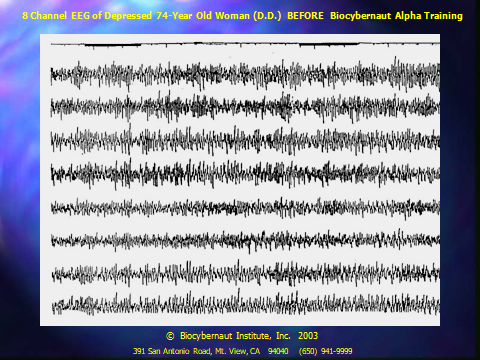
Brain aging shows up in the EEG data as reductions in Alpha amplitude, reductions in Alpha frequency and reductions in Alpha Hemi-Coherence over time. From the onset of
arteriosclerosis, the Alpha frequency tends to slow by roughly eight-tenths of one Hertz per decade, and once it falls below 8 Hertz (the bottom of the Alpha range), the record
shifts toward the slower Theta pattern associated with senility. Dr. Charles Yeager, a clinical electroencephalographer at Langley Porter (UCSF) had worked within the California
state hospital system and, at state request, had installed EEG equipment in every California state hospital. Every year he visited each hospital with technicians who recorded EEG
records for Dr. Yeager’s review. As Dr. Yeager put it memorably: “If an elderly patient had strong Alpha in their record, I knew they would still be alive next year.” (When Dr.
Yeager returned for his annual visit.) He continued, “But if their Alpha had diminished or was gone, I would say a special goodbye to that person, knowing it was unlikely they would
be alive when I returned next year.” The fact that Alpha slows and can vanish with age was documented decades ago by gerontology researchers including Obrist, Busse and Henry.
The Institute’s own founder is a data point. Dr. Hardt, born before the first atomic bomb was detonated in New Mexico in 1945, has run his Alpha at about 11.25 Hertz for years, a
fast Alpha frequency associated with higher IQ and a youthful brain. After a week of the Institute’s Fast Alpha feedback (Spring, 2026), which rewards only the fastest third of the
Alpha range, his Alpha frequency had risen to about 12.5 Hertz, showing that Alpha can both increase in amplitude and become faster. This is a single uncontrolled case and the
Institute presents it as one; his IQ was not measured before or after. Independent research confirms this same relationship between Alpha frequency and cognitive abilities: a 2024
study in The Journal of Neuroscience found that a lower resting Alpha peak frequency was associated with greater cognitive decline over roughly a decade, and other work links faster
Alpha to higher general cognitive ability. The Institute’s position, grounded in Dr. Hardt’s NIMH-sponsored research, is that the aging trajectory of the brain is not fixed, and
that appropriately lengthy and intense real-time Alpha feedback can accelerate the restoration of more youthful Alpha.
Finley et al., J. Neuroscience 44(13), 2024. | Grandy et al., NeuroImage 79, 2013.
How the Training Works
Trainees spend their week in comfortable, sensor-equipped feedback chambers: private, darkened rooms where EEG electrodes monitor Alpha brainwave activity in real time and convert
it into beautiful musical sound, rewarding increased Alpha with richer, fuller, more harmonious tones. The brain learns, session by session, to find the Alpha state more reliably.
Older trainees learn to increase their Alpha activity to more youthful levels and then they benefit in many ways.
When Dr. Hardt would describe the wide range of seemingly unrelated benefits from sustained Alpha feedback, listeners would sometimes say, “This sounds like snake oil. How can one
thing produce so many different results?” He would smile and answer that the training does only one thing: it improves central-nervous-system function. “Anything you want to do well
as a human being requires a well-functioning central nervous system. So when you improve the function of your central nervous system, everything you want to do, you can do better,
and every good thing you want to feel, you can feel more easily.” He adds a phrase the Institute has trademarked, Brain Waves Rule™: brain waves rule thoughts, feelings and
performance, so better brain waves make for a better life.
Evidence That Converges
The 1978 Science finding did not stand alone. A 2012 study in Advances in Mind-Body Medicine, using established instruments including the same MMPI test family, found statistically
significant improvement on 27 of 33 measures of personality and mood, confirming and extending the earlier anxiety results into a broader range of psychological benefits. A 2017
study using the same established psychological test instruments, including the MMPI, found that the benefits of the Biocybernaut Alpha training were still detectable up to 2½ years
after the training. Across five decades the Institute’s graduates have reported better sleep, more creative thinking, and a renewed engagement with daily life that appears to
persist after they leave Sedona. The Institute does not claim to know precisely why every improvement occurs, and notes that the science connecting specific protocols to specific
aging outcomes is still developing. What it can document is that the brainwave changes are measurable, and that they are accompanied by both measured and self-reported
quality-of-life gains across its older trainee cohorts.
The program is gentle enough for older trainees to complete comfortably while still being intensive enough to produce the brainwave changes the Institute looks for. Sedona’s
high-desert setting, clean air and low electromagnetic interference are particularly well suited to older nervous systems. The structured days, with education sessions, chamber
rotations, debriefs and nutritious meals provided on-site, are physically undemanding; lying down in a comfortable recliner during debriefs is encouraged. The Institute recommends
that anyone considering the program for cognitive or neurological concerns consult a physician before enrolling, and notes that it is not a substitute for medical care related to
dementia, cognitive decline or any other neurological condition.
A Famous Physician Who Came to Study at Biocybernaut
Dr. O. Carl Simonton, the pioneering psycho-oncologist whose counseling programs were documented to double the median survival time of patients with advanced metastatic cancer, did
the Alpha One training himself in 2003, bringing to the Biocybernaut Institute a quality rare even among clinicians: profound emotional insight. He could not only name and feel what
he was carrying; he could direct his attention toward it with therapeutic precision, and he could teach his patients how to do this in ways that extended their lives. After having
his emotional state assessed by the Biocybernaut computerized mood scales, he was shown to carry five distinct patterns of unresolved emotional content. Upon entering the feedback
chamber, he directed concentrated attention toward three of the five patterns. When his post-session assessments were scored, those three had resolved entirely. A fourth, which he
had worked on but not fully completed before the session ended, showed measurable partial reduction. The fifth, which time had not permitted him to address, showed no reduction. The
pattern was precise and unambiguous: the Institute’s proprietary assessment was tracking his inner work in real time, distinguishing completed emotional resolution from partial
work and from untouched charge with statistical clarity.
Dr. Simonton was so moved by what he personally experienced that he brought the story to colleagues at the highest levels of the National Institute of Mental Health, and he arranged
for a senior NIMH official to come with him to visit the Biocybernaut laboratory at 391 San Antonio Road in Mountain View, California. That official recognized both the power and
the uniqueness of the Institute’s proprietary emotional assessment methodology and offered Dr. Hardt a substantial federal grant in exchange for disclosure of the underlying
algorithms. Dr. Hardt received the offer with genuine gratitude and declined. The technology has remained proprietary to Biocybernaut ever since. Dr. Simonton affirmed that what he
had experienced was clinically extraordinary. The NIMH official’s decision to offer a federal grant for access to the methodology confirmed its uniqueness in the field.
“We are not claiming to reverse aging. What we can reliably do is help people reverse one of the most important indicators of aging in the brain, the loss of Alpha, a loss that
occurs naturally with age and that the Biocybernaut Alpha training can actually reverse. The brain stays plastic far later in life than most people assume, and it responds very well
to properly designed brain feedback at any age.”
Dr. James Hardt, Founder, Chairman, President, Biocybernaut Institute
—
About Biocybernaut Institute
Biocybernaut Institute is a high-performance training organization founded by Dr. James Hardt, with campuses in Sedona, Arizona and Bavaria, Germany. Its trainings use two
independent, synergistic Tracks. Track 1 is a series of research-guided neurofeedback programs based on electroencephalography (EEG); the Institute discovered and combined the
essential brain training parameters and patented both the technology and the methodology. Track 2 uses computerized assessment of moods and feelings, including measures that draw
upon unconscious emotions, with coaching by a Personal Trainer who helps integrate a trainee’s brainwave data and their growing understanding of their emotions for faster, deeper
and more permanent learning. For more than five decades, in three countries, and across more than $30 million of research and development, including $8.6 million in grants and
scholarship programs, Biocybernaut has taught voluntary brain-state and emotional self-regulation through its seven-day Alpha One, Higher Alpha and Theta programs, working with
executives, scientists, medical doctors, psychiatrists, athletes, performers, veterans and individuals pursuing personal growth. Over 6,000 people have trained with the Institute to
date. More at www.biocybernaut.com.
Biocybernaut Institute’s training is not a substitute for medical evaluation or care related to cognitive decline, dementia or other neurological conditions. Trainees with such
concerns should consult a physician before enrolling.
Media Contact
Biocybernaut Institute | Toll-free (North America): +1-855-260-1273 | Sedona +1-928-203-9000 | Bavaria +49-(0)-7562-985-9990 | Info@Biocybernaut.com | biocybernaut.com
Biocybernaut Institute
Biocybernaut Institute
+1 928-203-9000
Info@Biocybernaut.com
Visit us on social media:
LinkedIn
Instagram
Facebook
YouTube
TikTok
X
Beta Brainwaves vs. Alpha Brainwaves: Why The Average Person Is Stressed, Nervous And Anxious
Legal Disclaimer:
EIN Presswire provides this news content “as is” without warranty of any kind. We do not accept any responsibility or liability
for the accuracy, content, images, videos, licenses, completeness, legality, or reliability of the information contained in this
article. If you have any complaints or copyright issues related to this article, kindly contact the author above.

Media gallery
