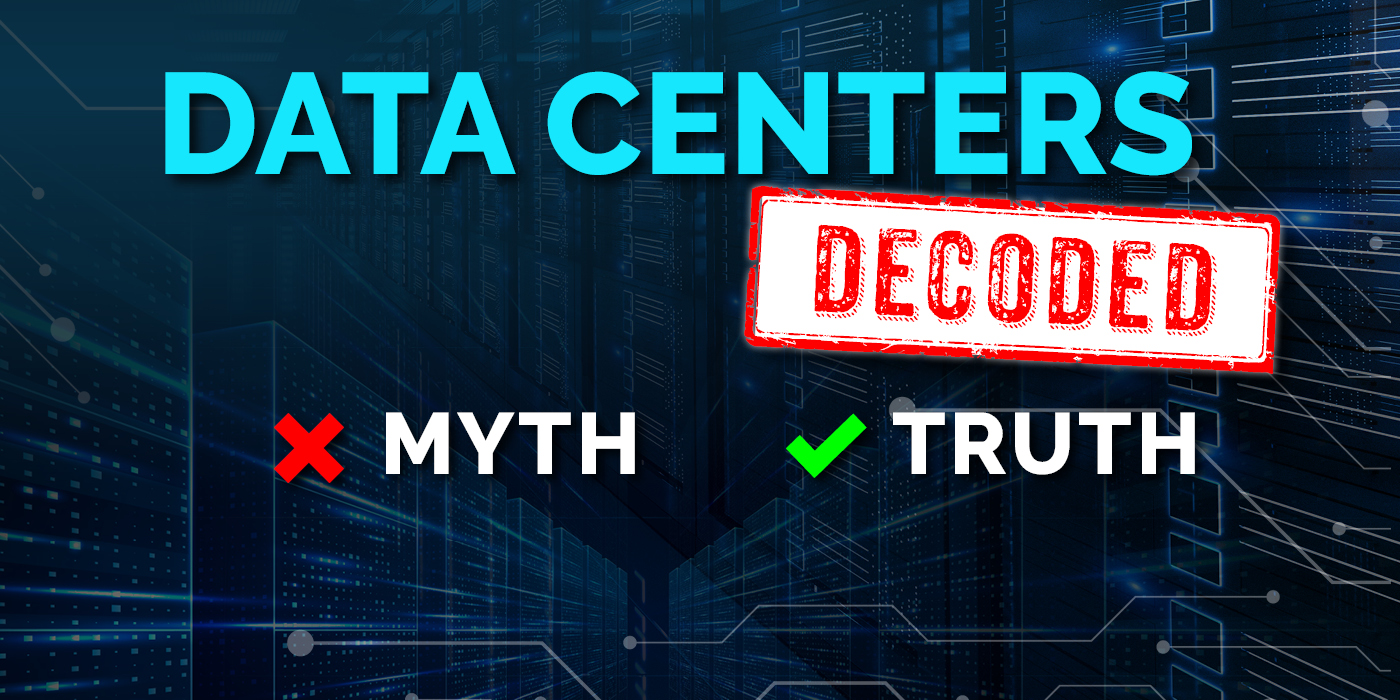
Data Centers Decoded Campaign Explores Modern Data Center Development
The Misconceptions Costing Projects, Communities, and the Industry LIVERMORE, CA, UNITED STATES, August 18, 2026
Press Release Disclaimer: This is a press release distributed through the XPR Media network. It has not been independently verified by our newsroom.

The Misconceptions Costing Projects, Communities, and the Industry
LIVERMORE, CA, UNITED STATES, August 18, 2026 /EINPresswire.com/ — One of the most important infrastructure projects being built in America right now is also one of the most misunderstood. And the gap between what people believe about data centers and what is true is costing projects, communities, and the industry more than anyone is willing to admit.
For Kier + Wright (K+W), closing that gap has become an important part of the firm’s role in the data center industry—bringing engineering expertise and real-world experience into a conversation too often shaped by misconceptions. That perspective is grounded in decades of experience delivering complex infrastructure.
K+W’s Chief Executive Officer and Co-Founder of KWRE, Chuck McCallum, PE, has spent his career engineering and delivering some of the most complex energy and infrastructure projects in the country. He has watched data centers evolve from modest urban facilities to the hyperscale campuses reshaping entire regions today. He understands what these projects require: the power planning, the water strategy, the permitting coordination, and the engineering decisions that determine whether a project moves or stalls. He is constantly in the rooms where those decisions are being made.
“Everybody wants to do a data center,” said McCallum. “But the myth that it can be done right away—that you find a piece of land near a power line and you are off to the races—is one of the most expensive misconceptions in the industry.”
Marilynn Stratton brings a different lens to the same conversation. She is at industry conferences, roundtables, speaking engagements, and in conversations with developers, communities, and decision makers across the country. As Chief Strategy Officer, she hears what developers are struggling with, what communities are afraid of, and what the industry is getting wrong. And what she has been hearing tells its own story.
“I was in an engineering meeting and someone on the energy committee said he hadn’t heard a good answer yet for why we need data centers,” said Marilynn Stratton, CPSM, Chief Strategy Officer at K+W and KWRE. “And I was flabbergasted—everything runs on a data center. Your banking. Your healthcare. Police and fire dispatch. Everything. And yet people are so unaware.”
That unawareness is not a character flaw. It is a communication failure. One the industry largely created for itself by staying quiet too long and letting misinformation fill the silence.
Data Centers Decoded was built for that moment. Not a sales pitch. Not a defense of an industry. A genuine effort to put the right information into a conversation that desperately needed it, grounded in engineering, shaped by experience, and driven by a belief that the projects worth building are worth understanding.
The facts, when presented clearly and honestly, tell a completely different story than the headlines.
Continue below to look back at our Data Centers Decoded campaign and explore the myths, truths, and engineering behind modern data center development.
Data Centers Decoded – Myth #1
MYTH: Data centers overload the electrical grid.
TRUTH: Reliable power is planned years before it’s needed.
Reliable power doesn’t happen by accident. Utilities, engineers, developers, and grid operators coordinate years in advance to forecast demand, complete interconnection studies, and determine what is needed to serve a facility reliably. Power availability can ultimately determine whether a project is viable, making this coordination one of the earliest and most important steps in data center development.
Data Centers Decoded – Myth #2
MYTH: Finding land is the hardest part of developing a data center.
TRUTH: Securing the right power can save 5+ years in the development process.
A site can check every box, including location, zoning, and acreage, and still fall short if it doesn’t have access to reliable power. Land may be secured in months, while the power needed to support a data center can take years. Understanding utility capacity and delivery timelines from the start can prevent teams from committing significant resources to a site that can’t support their vision.
Data Centers Decoded – Myth #3
MYTH: If a site is near a transmission line, it’s ready for a data center.
TRUTH: You can be next to a transmission line and still be years away from power.
Proximity doesn’t equal access. Think of a transmission line like a freeway. Living next to one doesn’t help if there’s no exit where you need it. Available electrical capacity, interconnection requirements, utility coordination, and the improvements needed to deliver power ultimately determine whether a site can support a data center.
Data Centers Decoded – Myth #4
MYTH: Data centers consume enormous amounts of water.
TRUTH: Many data centers use less water than a golf course.
There is no single answer to how much water a data center uses. Today’s facilities rely on a range of cooling technologies, including direct air, closed-loop, liquid, and hybrid systems, chosen according to climate, operational needs, and available resources. Looking at how a specific facility is designed provides far more meaningful context than applying one water-use number to an entire industry.
Data Centers Decoded – Myth #5
MYTH: Data centers are loud and create constant air pollution.
TRUTH: No combustion, no emissions — generators run only minutes a year.
A backup generator doesn’t tell the full story of how a data center operates. During normal operations, these facilities draw electricity from the grid and rely on electric cooling systems, while generators are reserved for emergencies and routine testing. Noise and air-quality impacts can also be addressed through equipment selection, acoustical studies, setbacks, placement, and other design decisions during planning and permitting.
Data Centers Decoded – Myth #6
MYTH: Building a successful data center starts with construction.
TRUTH: You can’t build your way out of poor planning.
Some of the most consequential decisions happen long before crews arrive on site. An unexpected utility upgrade, environmental constraint, or permitting requirement can disrupt schedules and budgets when discovered too late. Identifying those risks upfront gives teams more options to respond, greater control over costs, and more certainty as a project moves toward construction.
Data Centers Decoded – Myth #7
MYTH: Data centers are just another commercial development.
TRUTH: Data centers are critical infrastructure powering healthcare, banking, emergency services, cloud computing, and the modern economy.
Most of us rely on data centers before we even leave the house. Banking, healthcare, GPS, emergency services, cloud computing, and countless everyday digital interactions depend on facilities designed to operate reliably and without interruption. That responsibility makes data centers fundamentally different from traditional commercial development and changes how they must be engineered for reliability, connectivity, and resilience.
Data Centers Decoded – Myth #8
MYTH: Data centers don’t provide enough economic value to justify their investment.
TRUTH: Their impact extends far beyond the facility through jobs, infrastructure, tax revenue, and long-term investment.
A modern data center can represent hundreds of millions, and sometimes billions, of dollars in private investment. Its economic contribution begins before the doors ever open, generating construction jobs, local spending, tax revenue, utility improvements, and opportunities for vendors and service providers. That activity can also strengthen a region’s position for future investment and continued economic growth.
Data Centers Decoded – Myth #9
MYTH: Data centers consume valuable land without benefiting communities.
TRUTH: Modern data centers represent billions of dollars in local investment.
The value communities receive from data center development can take many forms. Across the country, investment associated with these projects has helped generate revenue for schools, public safety, utilities, and other community priorities while strengthening local infrastructure. The bigger question isn’t simply what occupies the land. It’s what that investment can make possible for the people who live there.
Data Centers Decoded – Myth #10
MYTH: A successful data center is designed for today’s needs.
TRUTH: The strongest data centers are built for what’s next, not what’s now.
Every data center is being designed for a future that is still taking shape. AI, cloud computing, and growing digital demand will continue changing what these facilities require, making flexibility essential from the beginning. The strongest sites are positioned to accommodate evolving technology, greater power needs, and future expansion without allowing today’s decisions to become tomorrow’s constraints.
Read the full breakdown here.
Kier + Wright
Kier + Wright
+1 925-245-8788
email us here
Visit us on social media:
LinkedIn
Instagram
Facebook
YouTube
X
Legal Disclaimer:
EIN Presswire provides this news content “as is” without warranty of any kind. We do not accept any responsibility or liability
for the accuracy, content, images, videos, licenses, completeness, legality, or reliability of the information contained in this
article. If you have any complaints or copyright issues related to this article, kindly contact the author above.

Media gallery