Makeup Remover Market to Reach USD 5.19 Billion by 2035 at 6.15% CAGR as Cleansing Oils and Online Retail Gain Momentum
The Makeup Remover Market is projected to reach USD 5.19 billion by 2035, driven by skincare awareness, organic
Press Release Disclaimer: This is a press release distributed through the XPR Media network. It has not been independently verified by our newsroom.
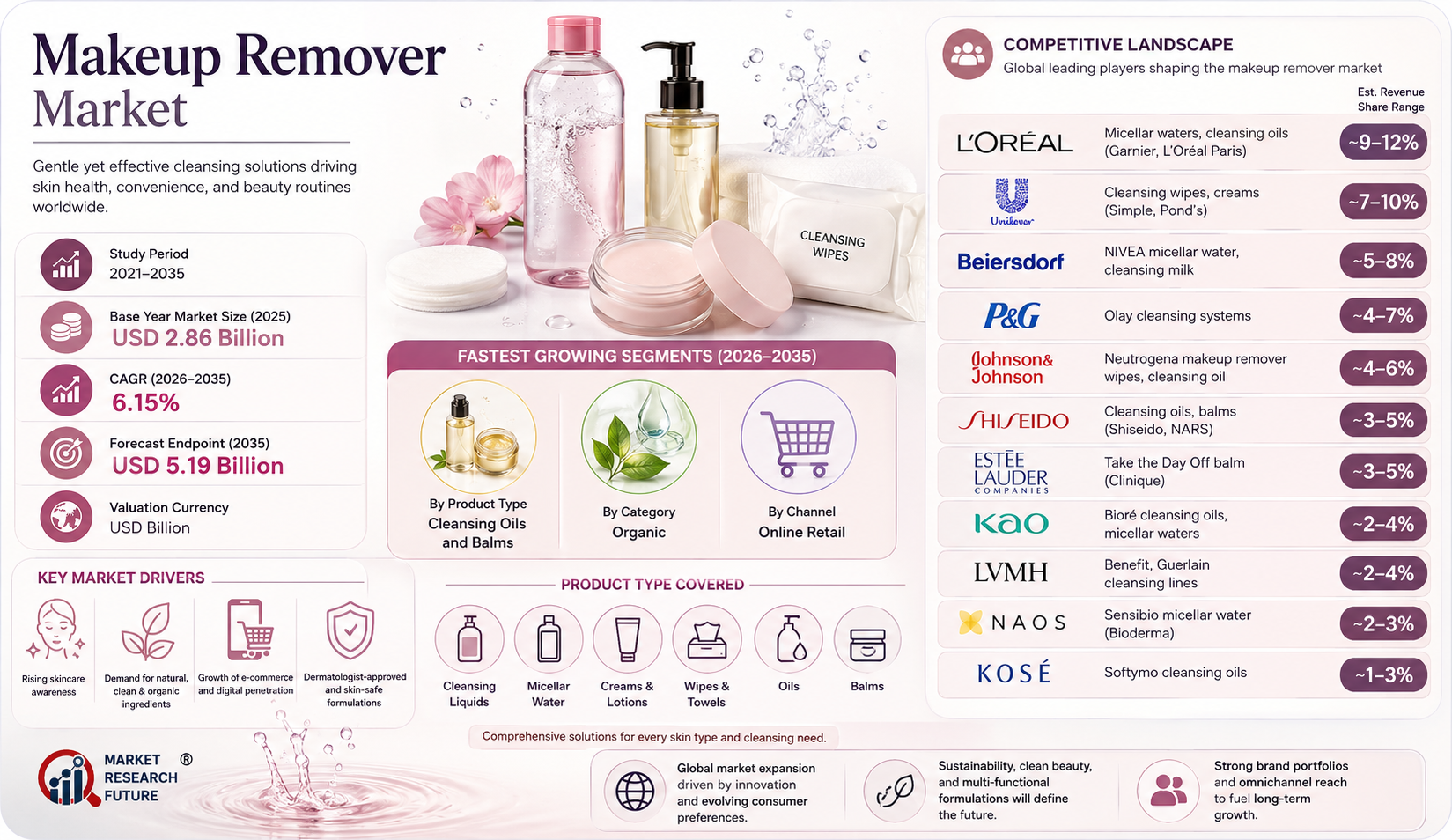

The Makeup Remover Market is projected to reach USD 5.19 billion by 2035, driven by skincare awareness, organic products, cleansing oils, and online retail.
NEW YORK, NY, UNITED STATES, August 24, 2026 /EINPresswire.com/ —
The global Makeup Remover Market is entering a period of sustained expansion as consumers increasingly connect makeup removal with broader skin-health and skincare routines. The market, valued at USD 2.86 billion in 2025, is projected to reach USD 5.19 billion by 2035, registering a 6.15% CAGR from 2026 to 2035. The study period covers 2021–2035, reflecting changes in consumer preferences, product innovation, retail formats, and ingredient expectations.
Makeup remover products have evolved from basic cleansing wipes and liquids into multifunctional formulations designed to remove cosmetics while supporting hydration, barrier protection, and skin comfort. This transition is particularly relevant as consumers use increasingly complex makeup formulations, including long-wear, waterproof, transfer-resistant, and high-pigment products. At the same time, demand is moving toward gentler formulations, convenient application formats, and products aligned with clean-beauty and skincare principles.
Competitive Landscape and Key Players
The competitive environment includes multinational beauty, personal-care, dermatological, and luxury companies. L’Oréal S.A., Unilever PLC, Beiersdorf AG, Procter & Gamble Co., Johnson & Johnson, Shiseido Company, Estée Lauder Companies, Kao Corporation, LVMH Moët Hennessy, Groupe NAOS, and Kose Corporation represent important participants across different price tiers and distribution channels.
L’Oréal maintains a broad mass-to-prestige position through micellar waters and cleansing oils under brands such as Garnier and L’Oréal Paris. Unilever competes through products such as Simple and Pond’s, supported by extensive global distribution. Beiersdorf emphasizes dermatological trust through NIVEA cleansing products, while P&G uses its skin-science capabilities to support Olay cleansing systems. Johnson & Johnson’s Neutrogena portfolio adds dermatological credibility. Shiseido, Estée Lauder, Kao, LVMH, NAOS, and Kose strengthen competition across premium, luxury, pharmacy, and Japanese beauty segments.
Free Sample Copy – Access A Complimentary Copy of Our Report to Explore Its Content and Insights
https://www.marketresearchfuture.com/sample_request/6796
Product Type Analysis
Product type is a central segmentation of the market and includes cleansing liquids, micellar water, creams, lotions, wipes, towels, oils, and balms. Each format addresses different consumer priorities, ranging from convenience and speed to deep cleansing and skin conditioning.
Cleansing liquids remain relevant because of their versatility and compatibility with different skincare routines. They are commonly positioned as straightforward solutions for removing foundation, concealer, blush, and other daily makeup products.
Micellar water has become an important category because it combines convenience with a lightweight cleansing experience. Its suitability for quick cleansing and its perceived gentleness have supported adoption among consumers seeking simplified routines.
Cleansing creams and lotions appeal to consumers prioritizing comfort and moisture retention. These formats can be particularly relevant for dry or sensitive skin routines because they are often formulated with emollient and conditioning ingredients.
Wipes and towels continue to benefit from portability and convenience, although consumers are increasingly evaluating these products according to skin sensitivity and environmental considerations. Reusable towels and alternatives to single-use formats can therefore influence future category development.
The fastest-growing product opportunity is expected to come from cleansing oils and balms. These products are particularly suited to removing waterproof and long-wear cosmetics and are closely associated with double-cleansing routines. Their ability to dissolve oil-based makeup while providing a richer cleansing experience is supporting increased consumer interest.
Category Analysis: Conventional and Organic
The market can also be differentiated by product category, particularly conventional and organic formulations. Conventional products continue to account for substantial demand because of their broad availability, established formulations, price accessibility, and extensive brand presence.
However, the organic segment is expected to grow at a comparatively faster pace as consumers become more attentive to ingredient sourcing, formulation transparency, plant-derived components, and perceived skin compatibility. The movement toward clean beauty is encouraging brands to explore botanical oils, naturally derived cleansing agents, and formulations positioned around fewer synthetic ingredients.
Organic makeup removers are also benefiting from the broader convergence of makeup and skincare. Consumers increasingly expect cleansing products to provide additional benefits such as moisturization, soothing, antioxidant support, and barrier care rather than functioning solely as cosmetic-removal products.
Distribution Channel Analysis
Distribution represents another important dimension of the Makeup Remover Market, with sales occurring through store-based and online retail channels. Supermarkets, hypermarkets, pharmacies, specialty beauty stores, department stores, and brand outlets remain important because consumers can physically evaluate products and access established brands.
The online retail segment is projected to be among the fastest-growing channels. E-commerce provides consumers with broad product selection, ingredient information, customer reviews, promotional comparisons, subscription opportunities, and access to international beauty brands. Digital channels are also particularly effective for niche organic products and premium cleansing formulations that may have limited physical distribution.
Social commerce and beauty-focused digital content can further influence purchasing decisions. Tutorials demonstrating double cleansing, waterproof makeup removal, and skincare routines can introduce consumers to new product formats and encourage experimentation.
Regional Market Perspective
Geographically, the market reflects different consumer behaviors and beauty routines across North America, Europe, Asia-Pacific, and other regional markets. North America benefits from established cosmetic consumption, premium skincare adoption, and strong online retail penetration.
Europe represents a mature beauty market where formulation quality, sustainability, product safety, and dermatological positioning can influence purchasing decisions. The region also provides opportunities for premium and organic cleansing products.
Asia-Pacific represents an important growth environment due to expanding beauty consumption, rising disposable incomes, growing urban populations, and strong interest in structured skincare routines. The popularity of Japanese and Korean beauty practices has also increased awareness of cleansing oils, balms, and double-cleansing methods.
Emerging markets across other regions provide additional opportunities as modern retail infrastructure expands and consumers gain greater access to international cosmetic brands.
Proceed To Buy – Move Forward with Your Purchase and Gain Instant Access to the Complete Report
https://www.marketresearchfuture.com/checkout?currency=one_user-USD&report_id=6796
Key Growth Drivers and Market Trends
Several factors are expected to shape market development through 2035. Rising cosmetic usage is a fundamental demand driver, while growing awareness of skincare hygiene encourages consumers to treat makeup removal as an essential daily step.
Product innovation is another major factor. Brands are developing multifunctional products that combine makeup removal with hydration, soothing, barrier support, and other skincare benefits. This allows makeup removers to compete within the broader facial cleansing and skincare ecosystem.
Ingredient consciousness is also becoming increasingly important. Consumers are examining labels more closely and showing greater interest in organic, botanical, fragrance-conscious, and skin-sensitive formulations. Sustainability considerations are influencing packaging, refill concepts, reusable cleansing accessories, and reduced dependence on disposable wipes.
Meanwhile, digital retail is changing how consumers discover and purchase products. Online platforms allow smaller brands and specialized formulations to reach consumers beyond traditional geographic boundaries.
Market Outlook
The Makeup Remover Market is expected to maintain a positive growth trajectory through 2035, supported by the convergence of cosmetics and skincare. The projected increase from USD 2.86 billion in 2025 to USD 5.19 billion in 2035, at a 6.15% CAGR, indicates continued demand for effective, convenient, and skin-conscious cleansing solutions.
Cleansing oils and balms, organic formulations, and online retail are positioned as particularly dynamic areas. Nevertheless, competitive success will depend on formulation performance, consumer trust, product differentiation, pricing, packaging innovation, and the ability to respond to changing expectations around ingredients and sustainability.
Overall, the market is shifting from simple cosmetic removal toward a more sophisticated cleansing category integrated with everyday skincare. Companies that effectively combine cleansing efficacy, skin compatibility, convenience, and evolving consumer values are likely to remain competitive as the global market expands.
FAQs
1. What is the projected size of the Makeup Remover Market by 2035?
The global Makeup Remover Market is projected to reach USD 5.19 billion by 2035, growing at a 6.15% CAGR from 2026 to 2035.
2. Which segments are expected to grow fastest in the Makeup Remover Market?
Cleansing oils and balms by product type, organic products by category, and online retail by distribution channel are identified as the fastest-growing segments.
Read Our Related Research Report
Makeup Tools Market –
https://www.marketresearchfuture.com/reports/makeup-tools-market-24808
Facial Makeup Market –
https://www.marketresearchfuture.com/reports/facial-makeup-market-26583
Clean Beauty Market –
https://www.marketresearchfuture.com/reports/clean-beauty-market-11976
Beauty And Wellness Products Market –
https://www.marketresearchfuture.com/reports/beauty-and-wellness-products-market-25592
Online Beauty and Personal Care Market –
https://www.marketresearchfuture.com/reports/online-beauty-and-personal-care-market-27892
Sagar Kadam
Market Research Future
+1 628-258-0071
email us here
Legal Disclaimer:
EIN Presswire provides this news content “as is” without warranty of any kind. We do not accept any responsibility or liability
for the accuracy, content, images, videos, licenses, completeness, legality, or reliability of the information contained in this
article. If you have any complaints or copyright issues related to this article, kindly contact the author above.

Media gallery