
Free Tuition Lines Reach $200,000 or More at 15 of 50 Highly Selective Colleges, Oriel Admissions Finds
Seven colleges add or raise a line for fall 2027, but 34 of the 38 published lines depend on typical assets, and few
Press Release Disclaimer: This is a press release distributed through the XPR Media network. It has not been independently verified by our newsroom.

Seven colleges add or raise a line for fall 2027, but 34 of the 38 published lines depend on typical assets, and few colleges say in dollars what that means
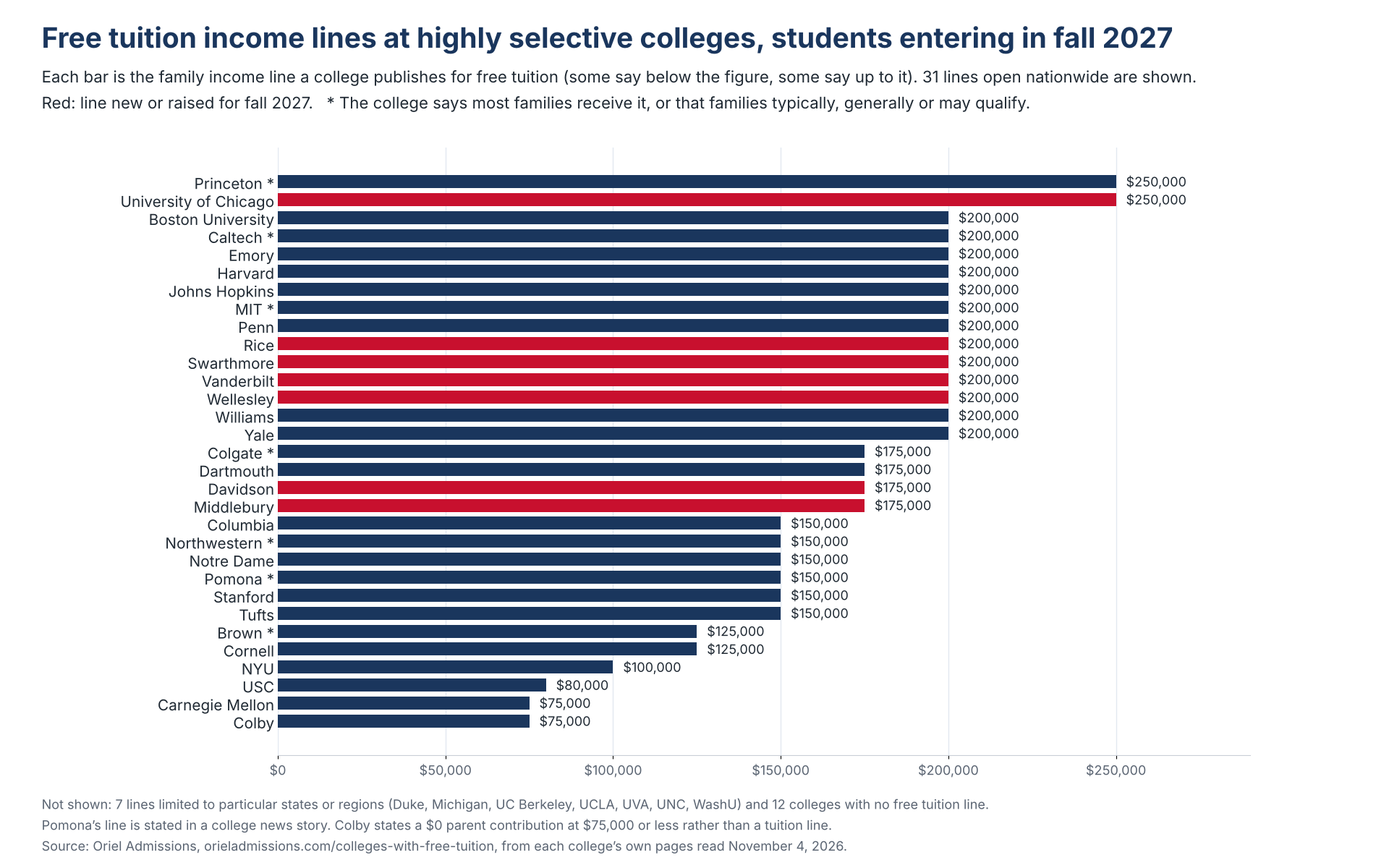
NEW YORK CITY, NY, UNITED STATES, November 4, 2026 /EINPresswire.com/ — Fifteen of 50 highly selective colleges now publish a free tuition line at a family income of $200,000 or more for students entering in fall 2027, according to a table of free tuition income lines published by Oriel Admissions, a college admissions consulting firm serving families nationwide. Princeton and the University of Chicago set theirs at $250,000. Thirty-eight of the 50 colleges publish a family income line for free tuition, and seven of them add or raise a line for the class now applying.
The 15 colleges with a free tuition line at $200,000 or more for fall 2027 entry:
• Princeton University: up to $250,000, for most families, in place since fall 2025.
• University of Chicago: below $250,000, starting in Autumn Quarter 2027.
• Boston University, Caltech, Emory, Harvard, Johns Hopkins, MIT, the University of Pennsylvania, Rice, Swarthmore, Vanderbilt, Wellesley, Williams and Yale: $200,000, worded by the colleges in several ways, from below $200,000 to up to $200,000.
Seven colleges change their lines for students entering in fall 2027. Rice raises its line from $140,000 to $200,000, and Vanderbilt and Wellesley raise theirs from $150,000 to $200,000. Swarthmore adds a line at $200,000, the University of Chicago sets its line at $250,000, and Davidson and Middlebury add lines at $175,000. Across the group, at least 20 of the 38 lines took effect or rose for students entering in fall 2025 or later.
The fine print varies more than the headline figures. On the colleges’ own pages, 34 of the 38 lines depend on the family’s assets as well as its income, usually through the phrase “typical assets.” At least seven colleges put a number on that test: Johns Hopkins (assets generally less than three times annual income), Columbia (up to approximately $250,000 for incomes up to $150,000), Vanderbilt (a parent net worth under $250,000), Penn (liquid assets of $50,000 or less), Princeton (a formula that counts 5% of assets above $175,000), and, for state residents, the University of Michigan (assets below $125,000) and the University of Virginia (assets under $100,000). The rest list the kinds of assets they review or leave the term undefined.
The colleges also differ on the family home. Fourteen of the 38 count home equity in some form, including Columbia, Cornell, Dartmouth, Duke, Michigan, NYU, Rice, Williams and Yale. Fourteen, including Harvard, MIT, Penn, Princeton, Stanford, the University of Chicago, Vanderbilt and Washington University in St. Louis, leave the primary home out, in Harvard’s case typically. The rest do not say clearly on the pages read. For a family whose savings are mostly in a house, the same income can mean free tuition at one college and a contribution at another.
Free tuition is also not a free education. At Harvard, tuition for 2026-27 is $62,226 of $91,634 in billed costs. Many colleges set a second, lower line, most often $100,000, at or below which parents pay nothing or billed costs are covered, and assess housing and food by need above it. The 2026-27 Ivy League cost of attendance at each college is in a separate Oriel Admissions guide.
Twelve of the 50 colleges publish no free tuition line, among them Amherst, Bowdoin and Wesleyan, which say they meet full demonstrated need without loans. A missing line does not mean less aid.
“A free tuition line tells a family where to start, not what they will pay,” said Rona Aydin, founder of Oriel Admissions. “Most of these lines depend on assets the college does not put a number on, and a family with savings or a valuable home can fall outside a line its income meets. Families should run each college’s net price calculator before the list is final.”
Methodology
The 50 colleges are the set Oriel Admissions tracks in its College AI Policy Index: highly selective US colleges and universities with first-year acceptance rates of roughly 20% or lower in recent cycles. Oriel Admissions read each college’s financial aid, admissions and news pages on November 4, 2026, and recorded the published line, its wording, the full-cost line, the asset and home equity terms, residency and citizenship limits, and the start date; a second reader then checked every line against the same official pages. Seven of the 38 lines are limited to students from particular states or regions and are marked in the table. Awards chosen after a separate review, such as the Georgia Tech Promise, are not counted as lines. Lines that a college describes as applying to most families are included and marked. The full table is at https://orieladmissions.com/colleges-with-free-tuition/ and may be reproduced with credit to Oriel Admissions.
About Oriel Admissions
Oriel Admissions is a college admissions consulting firm serving families nationwide on elite university admissions strategy, with offices in Princeton, New Jersey and New York. The firm and its founder, Rona Aydin, have been featured on the NPR program 1A and in The Hechinger Report. Oriel Admissions also publishes the College Admissions Transparency Index and the College AI Policy Index.
Rona Aydin
Oriel Admissions
hello@orieladmissions.com
Legal Disclaimer:
EIN Presswire provides this news content “as is” without warranty of any kind. We do not accept any responsibility or liability
for the accuracy, content, images, videos, licenses, completeness, legality, or reliability of the information contained in this
article. If you have any complaints or copyright issues related to this article, kindly contact the author above.

Media gallery
